
2026-10-05
The Building Modernization Act (GModG): Obligations for Nonresidential Buildings

The Building Modernization Act (GModG) is the amendment to the German Buildings Energy Act. It was adopted by the German Bundestag on July 10, 2026 and entered into force upon publication in the Federal Law Gazette on July 29, 2026. The statute sets energy requirements for heated or air-conditioned buildings and implements a binding roadmap for decarbonizing and digitizing the building stock in Germany.
For owners, investors, and operators of nonresidential buildings, this means: stricter efficiency requirements for new builds and existing buildings, new obligations for building automation and control, revised heating rules, an expanded solar requirement, and a renewed system of energy performance certificates.
What Is the Building Modernization Act (GModG)?
The Building Modernization Act (GModG) is a German federal law that aims to improve the energy efficiency of buildings step by step and to enable a climate-neutral building stock by 2045, as anchored in the German Climate Change Act. It replaces and updates central parts of the previous German Buildings Energy Act (GEG) and transposes binding European requirements, particularly the EU Energy Performance of Buildings Directive (EPBD), into national law.
For nonresidential buildings, the law pursues three core goals:
- New buildings are to be constructed as zero-emission buildings from the end of this decade.
- Existing buildings are to be led out of the worst-performing segment step by step via Minimum Energy Performance Standards (MEPS).
- Technical systems, especially heating, ventilation, and air conditioning, are to be operated efficiently, digitally monitored, and proactively adapted.
Below we outline the most important new regulations and deadlines for nonresidential buildings and the relevant paragraphs.
Which Obligations Apply to New Buildings?
With Section 10a GModG, a binding zero-emission standard is introduced for new nonresidential buildings from January 1, 2028:
A zero-emission building under the GModG in particular means:
- The total energy demand for heating, domestic hot water, ventilation, cooling, and built-in lighting must not exceed the respective maximum values under Sections 15 or 18 GModG.
- Heat and cooling energy losses must be limited through appropriate building envelope insulation pursuant to Sections 16 or 19 GModG.
- No on-site CO₂ emissions from fossil fuels may be caused at the building location.
Implication for new-build pipelines:
For ongoing developments, the focus - besides a high-performance building envelope - shifts away from fossil fuels toward electrified heat generators (e.g., heat pumps), self-generated electricity (e.g., photovoltaics), and intelligent building automation that anticipates energy use based on weather, occupancy, and the availability of renewables. These requirements should be integrated consistently from the planning phase.
Which Obligations Apply to Existing Buildings?
With Section 40 GModG, Germany is introducing, from January 1, 2027, Minimum Energy Performance Standards (MEPS) for existing nonresidential buildings for the first time. For the annual primary energy demand for heating, domestic hot water, ventilation, cooling, and built-in lighting, the following steps apply:
Implication for existing portfolios:
For owners and asset managers, Section 40 GModG means that buildings with very high primary energy demand will be in breach of regulation from 2030 if no modernization occurs. Early portfolio screenings will be necessary to identify energetic laggards and to plan modernization budgets with precision. Digital energy management and monitoring help compare actual consumption with calculated metrics early and set priorities.
What Changes for Heating System Replacement?
The new heating rules in Sections 42–46 GModG are often discussed in the residential context but are also relevant for nonresidential buildings:
- The previous blanket 65 % renewable-energy requirement for heating system replacement is abolished without replacement.
- New gas, heating oil, or liquefied petroleum gas systems remain permissible in principle, but must use minimum shares of climate-neutral fuels that increase over time (“bio-staircase”):
Fulfillment options include, among others:
- Electrically driven heat pumps or hybrid heat pump systems
- Biomass; green, blue, orange, or turquoise hydrogen, including derivatives
- Solar thermal systems or hybrid solar thermal systems
- Direct electric heating or connection to a district heating network
This new rule was one of the most debated elements during the legislative process, also because “green” fuels such as biomethane are foreseeably scarce.
Implication for heating planning:
Traditional fossil heating systems remain formally possible but are tied to rising shares of climate-neutral fuels whose costs and availability remain uncertain today. Continuing to rely on gas for heating entails price and dependency risks. To reduce regulatory risk and future CO₂ costs, an early switch to electric alternatives, such as heat pumps (which, contrary to common perception, can both heat and cool) pays off for nonresidential buildings.
What Applies to Building Automation and Control?
The new obligations for building automation and control systemns (BACS) in Section 56 GModG are particularly far-reaching for the operation of nonresidential buildings. They replace the previous Section 71a GEG and anchor digital monitoring and reduction of energy consumption as the standard for almost all larger nonresidential buildings.
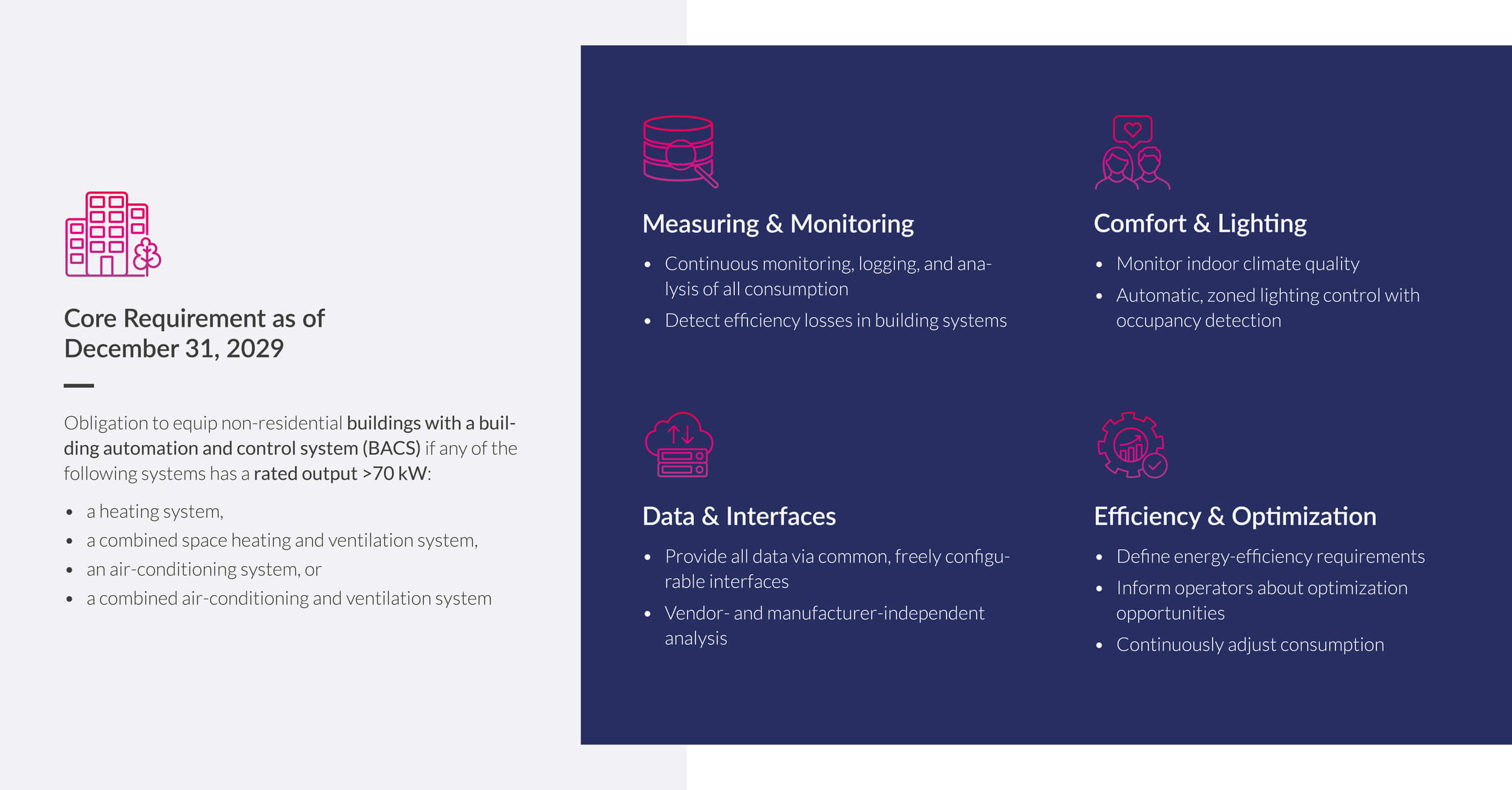
The requirements will apply to systems with more than 70 kilowatts of rated output (previously 290 kilowatts) for heating, ventilation, or air conditioning. By December 31, 2029, virtually all nonresidential buildings must therefore be equipped with a building automation and control system.
Requirements for building automation from 2030
- Measure consumption and operation: Continuously monitor, log, and analyze consumption of all main energy carriers and building services systems; automatically adjust energy consumption based on these insights.
- Make data usable: Provide all data via open, freely configurable interfaces to enable vendor-agnostic analysis.
- Safeguard efficiency: Define target values for energy efficiency; detect efficiency losses in building services systems; inform the operator about optimization opportunities.
- Monitor quality of use: Monitor indoor climate quality and provide automatic, zoned lighting control with occupancy detection.
New buildings with systems of more than 70 kW must also undergo technical commissioning management, including balancing of building services systems, covering at least one heating or cooling season. For systems greater than 290 kW, automation class B according to DIN/TS 18599‑11: 2025‑10 is mandatory; for systems with more than 70 kW, automation class C is mandatory.
Implication for owners and operators:
From December 31, 2029, almost all commercial buildings with heating, cooling, and/or ventilation systems with more than 70 kW of rated output must comply with the requirements of Section 56 GModG. This is not a distant obligation, but an immediate strategic course correction. Bringing a nonresidential portfolio into compliance before the end of 2029 protects portfolio value and leverages digitization as a competitive advantage.
Comply With Section 56 GModG Without Refurbishment: The Certified Solution From aedifion
The aedifion solution is certified by TÜV Rheinland under Section 56 GModG (certificate), as it was previously under Section 71a of the German Buildings Energy Act (GEG). It operates vendor-agnostically on top of the existing building technology and can be deployed in both new construction and existing buildings via plug-and-play or as a minimally invasive retrofit.
The software modules listed above cover the requirements of Section 56 (2) for existing buildings as follows:
For new non-residential buildings, we verify whether the asset meets the prerequisites to achieve the level of automation required by DIN/TS 18599-11:2025-10 with our .controls software module.
- Class B for systems above 290 kW
- Class C for systems above 70 kW
Where needed, we implement, in partnership with the building automation contractor, a complete system combining local building automation and a cloud platform that achieves the required level of automation.
Act Now — Not in 2029
Digitally optimizing operations in line with Section 56 GModG already pays off today—economically, financially, and in terms of regulatory risk. Learn more about meeting the requirements with aedifion.

What Applies to Maintenance and Servicing?
The existing requirements for maintenance and servicing of heating and heat pump systems largely remain:
- Section 60a GModG (inspection and optimization of heat pumps) remains in force. New: in addition to manual inspection and remote monitoring, a maintenance contract is now recognized as a standalone fulfillment option.
- Section 60b GModG (inspection and optimization of older heating systems) and Section 60c GModG (hydraulic balancing and further measures for heating optimization) remain unchanged.
Implication for operations:
For owners and operators, the obligation to systematically optimize technical building systems remains. Digital monitoring solutions and building automation systems make compliance easier by detecting deviations early and documenting optimization suggestions with data.
Energy Performance Certificates and Efficiency Classes
With the GModG, the legislator is fundamentally renewing the system of energy performance certificates for nonresidential buildings.
- New A–G efficiency scale (Annex 10a GModG): The energy efficiency of nonresidential buildings will be indicated using a harmonized EU A–G scale under EPBD 2024/1275/EU. The basis is a calculated standard primary energy demand per DIN/TS 18599 relative to a reference building.
- Demand-based certificate for nonresidential buildings (Section 81 GModG): For all nonresidential and mixed-use buildings, a demand-based certificate based on an energy balance will be mandatory. Additional required information includes operational CO_2 emissions, life-cycle greenhouse gas emissions, and the building’s ability to respond to external signals and adjust energy consumption.
Implication for reporting and transactions:
With the new demand-based certificates, the calculated energy demand of nonresidential buildings moves more into focus. For operational control of costs and emissions, however, actual consumption remains decisive. Professional owners and investors should therefore combine both: legally compliant demand-based certificates and continuous consumption monitoring in accordance with Section 56 GModG.
Solar Requirement for Nonresidential Buildings
With Section 106 GModG, the legislator introduces a phased solar requirement that particularly affects public nonresidential buildings and commercial utility buildings. By January 2031, this will apply to all existing public nonresidential buildings with a usable floor area over 250 m² as well as to new covered parking areas (e.g., carports).
The solar requirement complements a series of policy shifts around self-generated electricity and intelligent energy management. Example: With the amendment of the German Energy Industry Act (EnWG), electric vehicles in Germany can not only draw power but also feed it back economically, as they are treated like other electricity storage and are no longer subject to double network charges.
Implication for space strategy:
The solar requirement strengthens the role of roof and parking areas as energy generators. For owners and asset managers, early spatial analysis pays off to integrate solar potential into a self-generation concept. Demand Side Management and the use of intelligent energy storage offer additional attractive options to optimize not only the production but also the consumption of renewable electricity.
Implementing GModG Requirements in a Nonresidential Portfolio
The GModG is not a distant obligation but an immediate strategic course correction for owners, asset managers, and operators of nonresidential buildings.
Those who adopt digital operational optimization early reduce consumption and CO₂ costs, lay the foundation to benefit from dynamic electricity tariffs and Demand Side Management, and at the same time create the auditable data basis increasingly required by financial market regulation and ESG reporting.
Implementation of the GModG thus becomes a lever to secure the long-term value of nonresidential portfolios and to demonstrate their future fitness in the market.
FAQ: Building Modernization Act
When Does the GModG Enter into Force?
The Building Modernization Act (GModG) entered into force immediately upon publication in the Federal Law Gazette, and thus on July 29, 2026. Some provisions enter into force in stages. For example, the binding zero-emission standard for new nonresidential buildings applies from January 1, 2028.
How Long Does the German Buildings Energy Act (GEG) Remain Valid?
The German Buildings Energy Act (GEG) was superseded by the Building Modernization Act (GModG) upon its entry into force on July 29, 2026. Since then, the GModG has fully replaced the GEG and constitutes the new legal framework for new construction and the operation of nonresidential buildings.
What Risks and Sanctions Arise From Non-Compliance With the GModG?
Ignoring the GModG risks both regulatory sanctions and structural devaluation of a portfolio. In addition to official fines, financiers and investors already price in digital controllability, data availability, and ESG compliance. The link between asset value development and energy efficiency is empirically documented.
Which Buildings Are Covered by the Retrofit Obligation Under Section 56 GModG?
The retrofit obligation for building automation applies to all nonresidential buildings whose heating system, combined heating/ventilation system, air-conditioning system, or combined cooling/ventilation system has a rated output of more than 70 kW. From December 31, 2029, this will affect a large share of Germany’s commercial nonresidential building stock.
Does the 70 kW Rated Output in Section 56 GModG Refer to Individual Units/Generators or Their Sum?
Section 56 GModG and Article 13 of the underlying EPBD refer to the energy use of the entire building, not to individual components. By definition, a building has one heating system or a combined heating/ventilation system or a cooling system. The term always refers to the overall system comprising all individual generators. The decisive factor is therefore the aggregate output of the installed heat generators, regardless of how many boilers, heat pumps, etc. are present or whether redundant generators were installed for security of supply.
Which aedifion solution is certified under Section 56 GModG?
For existing buildings, the software bundle comprising .io and .analytics (Section 56 (2)); for new buildings, .controls is added (Section 56 (3)). TÜV Rheinland has tested and certified it (Certificate-ID: C01-2026-10-21281602). Assets already certified with aedifion under Section 71a of the German Buildings Energy Act (GEG) require no further action.
Is My Existing Building Automation Sufficient, or Is Investment in a New Solution Required?
Whether an existing building automation system suffices depends on functionality: it must continuously monitor, log, and analyze consumption; provide open interfaces; detect efficiency losses; and support optimization. If functions are missing, they can in many cases be retrofitted via plug-and-play or by a digital retrofit with additional hardware. The first step is always a structured target/actual review against the statutory minimum requirements.
Are There Exceptions to the Building Automation Obligation Under Section 56 GModG?
Exceptions apply only where installation is technically impossible or economically unreasonable, as well as for certain buildings related to national and alliance defense. For systems installed up to three years before entry into force, extended retrofit deadlines apply. In all cases, a plausible, documented justification is required. Generic references to effort or cost are insufficient.
Does Section 56 GModG Also Apply to My Existing Heating System in a Nonresidential Building?
Yes. Section 56 GModG applies to all heating, ventilation, and air-conditioning systems with more than 70 kW of rated output, regardless of whether the system is renewed. The implementation deadline runs until December 31, 2029.
Which Funding Programs Are Linked to the GModG?
The Federal Funding for Efficient Buildings (BEG) will continue in parallel with the GModG and be adapted to the new legal framework; the new funding guideline applies to applications from July 21, 2026. Applications approved before July 20 are not affected by the changes. Questions and answers regarding funding and grants are provided by the Federal Ministry for Economic Affairs and Climate Action (BMWK) at energiewechsel.de.
Our research and assessments are based on the current legal situation but do not constitute legal advice.
Buildings Simply Made Better
Get in Touch With US!
In a one-on-one meeting, we will clarify your specific requirements and demonstrate how our AI-based cloud solutions and service packages can benefit you.